

Cooperation Between Iran and Afghanistan
Introduction
Economic relations between Iran and Afghanistan constitute one of the most significant bilateral interactions in the broader region of Southwest and Central Asia. Due to their shared border, cultural proximity, and complementary economic structures, the two countries have developed a trade relationship that extends beyond ordinary commercial exchange. Iran functions as a major supplier of industrial goods, petroleum products, electricity, and construction materials, while Afghanistan represents both an important export destination and a strategic transit partner. In recent years, trade between the two countries has gained additional importance because of Afghanistan’s limited industrial base, dependence on imported energy, and need for reliable access to maritime trade routes.
Bilateral Trade Volume and Commercial Significance
The trade relationship between Iran and Afghanistan has historically been weighted strongly in favor of Iran. Afghanistan is one of the major destinations for Iranian non-oil exports, particularly in eastern regional markets. Iranian exports to Afghanistan typically include food products, cement, steel, petroleum derivatives, liquefied gas, household goods, ceramics, machinery, and electricity. In contrast, Afghan exports to Iran remain more limited and are mostly concentrated in agricultural and raw-material categories such as dried fruits, medicinal plants, saffron, minerals, and coal.
From a macroeconomic perspective, the bilateral trade volume has fluctuated depending on border conditions, security developments, currency instability, sanctions, and customs regulations. Nevertheless, the commercial linkage remains structurally strong because Afghanistan depends heavily on neighboring countries for essential commodities, and Iran benefits from a geographically accessible export market. This trade pattern is especially important for Iranian border provinces, where cross-border commerce contributes directly to employment, logistics activity, warehousing, and transportation services.
Composition of Iranian Exports to Afghanistan
Iranian exports to Afghanistan are highly diversified, which strengthens Iran’s role in the Afghan market. Among the most important exported products are:
- Petroleum products, including diesel, gasoline-related derivatives, liquefied petroleum gas, and bitumen
- Construction materials, especially cement, iron products, tiles, glass, and sanitary equipment
- Food and agricultural goods, such as dairy products, packaged foods, flour, and processed items
- Electricity, supplied to several Afghan provinces near the border
- Consumer and industrial goods, including detergents, plastics, machinery, and light industrial equipment
This export structure demonstrates that Iran’s role in Afghanistan is not confined to one sector. Rather, Iran provides inputs necessary for both daily consumption and long-term infrastructure development. In particular, the construction sector in Afghanistan relies heavily on Iranian materials because of proximity, lower transportation costs, and relatively competitive pricing.
Energy Trade and Strategic Dependence
One of the most critical dimensions of bilateral relations is energy cooperation. Afghanistan has long faced structural shortages in domestic energy generation, fuel refining capacity, and transmission infrastructure. As a result, it depends substantially on neighboring countries for electricity imports and fuel supplies. Iran plays an important role in this context by exporting both refined petroleum products and electricity to Afghanistan.
Electricity Exports
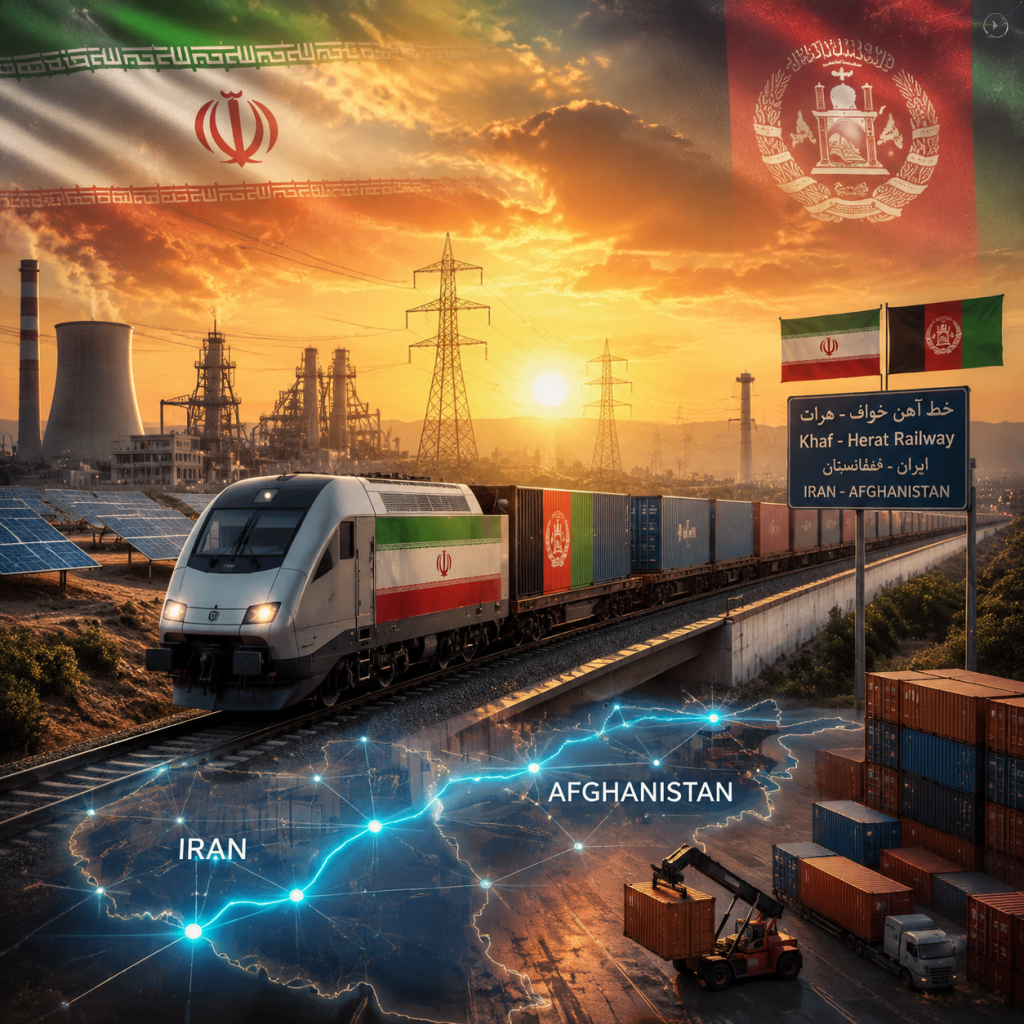
Iran supplies electricity to several western Afghan regions, particularly areas close to the border such as Herat and neighboring provinces. This electricity trade is strategically important for three main reasons:
- Grid support for Afghanistan: Many Afghan provinces lack sufficient domestic generation capacity, making imported electricity essential for residential use, public services, and commercial activity.
- Revenue generation for Iran: Electricity exports represent a stable source of foreign income and support the broader objective of expanding non-oil regional trade.
- Regional influence through infrastructure: Power transmission creates long-term interdependence, since energy infrastructure requires continuity, technical coordination, and political cooperation.
Electricity exports also reinforce Iran’s image as a reliable energy supplier in the region. For Afghanistan, imported electricity is often cheaper and faster to secure than building large-scale thermal or hydroelectric capacity in the short term.
Petroleum Products and Fuel Supply
Fuel trade is equally significant. Afghanistan’s limited refining capacity means that much of its transportation, agricultural machinery, and industrial fuel demand must be met through imports. Iran is well-positioned to supply these needs because of its refining infrastructure, road connectivity, and proximity to major Afghan commercial centers.
Products such as diesel, liquefied gas, and bitumen are especially important. Diesel is vital for transportation fleets, backup electricity generators, and agricultural equipment. Liquefied gas is widely used for domestic heating and cooking. Bitumen and related petroleum materials are essential for road construction and urban development.
This pattern makes energy exports not only a commercial matter but also a factor in infrastructure formation and socioeconomic stability inside Afghanistan.
Transit Routes and Energy Logistics
The role of logistics in Iran-Afghanistan trade cannot be overstated. The border crossings of Dogharoon, Milak, and Mahiroud are central to the movement of goods, including energy products. Efficient customs procedures, road security, and warehousing capacity directly affect fuel delivery and commodity pricing inside Afghanistan.
Additionally, the development of Chabahar Port gives Afghanistan access to imported and re-exported goods through Iranian territory. Although Chabahar is often discussed primarily in geopolitical terms, it also has substantial commercial relevance for energy logistics, industrial imports, and supply-chain diversification. For a landlocked country like Afghanistan, reduced dependence on a single external trade route is economically and strategically valuable.
The Khaf-Herat railway further strengthens long-term trade potential. Rail connectivity can lower transportation costs for bulk commodities such as cement, steel, minerals, and potentially fuel-related cargo. In the long run, this can improve trade efficiency and reduce transaction costs across the bilateral economic corridor.
Economic and Structural Challenges
Despite strong complementarities, several challenges continue to limit the scale and efficiency of trade and energy cooperation.
Financial and Banking Constraints
One of the major obstacles is the difficulty of conducting formal financial transactions. Sanctions affecting the Iranian financial system, combined with Afghanistan’s underdeveloped banking infrastructure, complicate trade settlements, letters of credit, and currency transfers. This often pushes businesses toward cash-based or informal mechanisms, which increase risk and reduce transparency.
Political and Regulatory Instability
Political uncertainty in Afghanistan discourages long-term industrial investment and creates unpredictability in customs and trade regulations. Even where demand exists, the lack of policy consistency may prevent larger contracts in areas such as electricity infrastructure, industrial equipment, and technical services.
Informal Trade and Smuggling
A considerable share of cross-border exchange takes place through informal or undocumented channels. This affects state revenues, weakens regulatory oversight, and can distort market prices. In the energy sector, informal fuel trade is particularly sensitive because it influences domestic pricing, subsidy exposure, and border security management.
Infrastructure Gaps
Although border trade remains active, transport bottlenecks, storage limitations, and insufficient modern customs systems continue to reduce efficiency. Energy trade, especially fuel exports, requires dependable logistics, regulatory supervision, and stable border operations.
Future Outlook
The future of Iran-Afghanistan economic relations depends on whether both countries can move from a predominantly necessity-based trade model to a more structured and development-oriented partnership. Several areas offer strong future potential:
- Expansion of cross-border electricity networks
- Greater Iranian participation in Afghan infrastructure development
- Increased transit use of Chabahar Port
- Mining and mineral processing cooperation
- Formalization of fuel and commodity trade through improved customs and banking channels
If these areas are developed systematically, bilateral trade could become more diversified, sustainable, and resilient. Energy cooperation, in particular, may serve as the foundation for broader industrial integration, since electricity and fuel access are prerequisites for manufacturing, transport, and urban growth.
Conclusion
Trade between Iran and Afghanistan is not merely a matter of neighboring exchange; it is a structurally important economic relationship shaped by geography, necessity, and regional strategy. Iran has established itself as a major supplier of fuel, electricity, construction materials, and essential goods to Afghanistan, while Afghanistan offers Iran an accessible export market and long-term opportunities in transit, mining, and infrastructure cooperation. Among all dimensions of this relationship, energy remains one of the most strategically significant. The extent to which this partnership can expand in the future will depend on improvements in infrastructure, banking mechanisms, regulatory stability, and regional political conditions.


Recent Comments