

Abstract
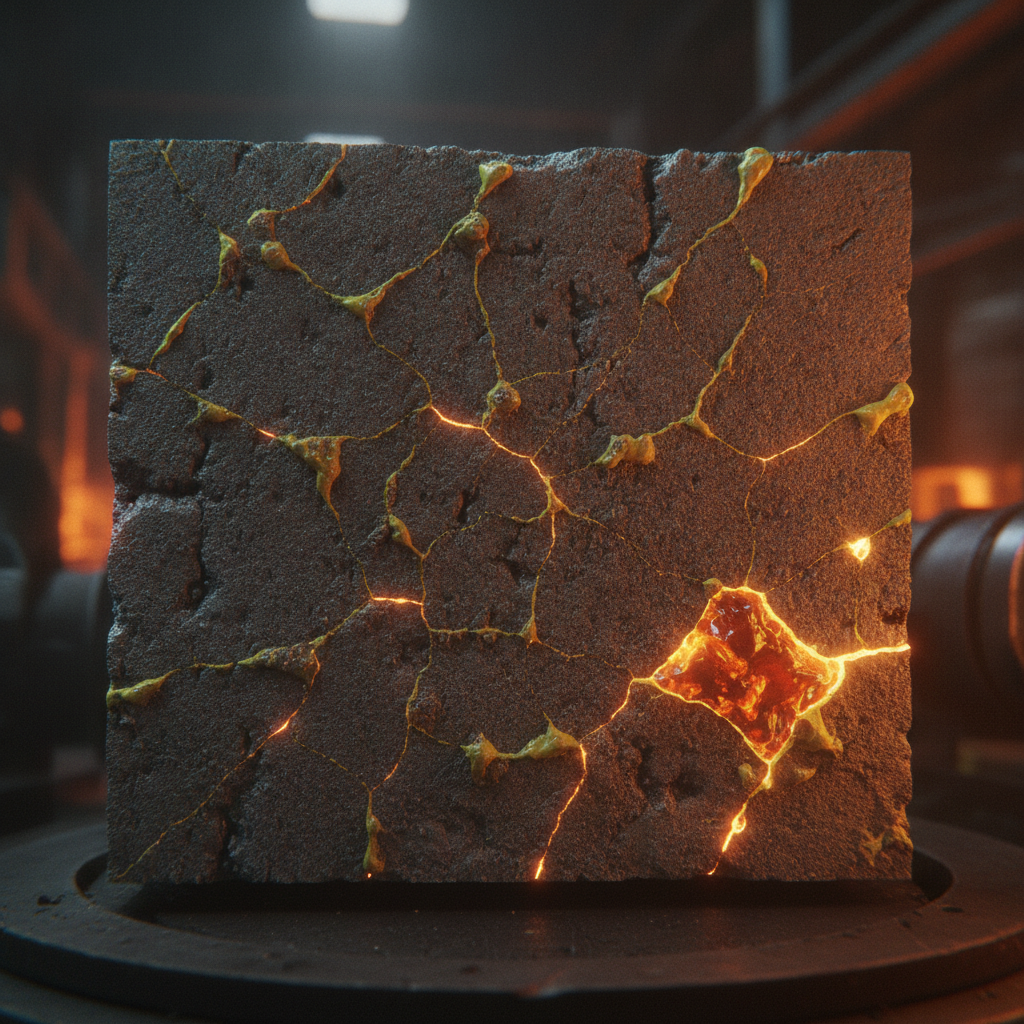
Refractory materials are critical components in industrial high-temperature processes. The integrity, lifespan, and thermal efficiency of these materials are heavily dependent on their chemical purity. Sulfur (S), often present as an impurity in raw materials or fuel sources, poses significant challenges to the structural stability of refractories. This article explores the deleterious effects of sulfur on the quality and longevity of refractory items, specifically focusing on thermochemical degradation mechanisms.
1. Introduction: The Sensitivity of Refractories
Refractory materials ( such as alumina (Al2O3), magnesia (MgO), and silica (SiO2) ) are designed to withstand extreme thermal, mechanical, and chemical stress. Any deviation in chemical composition can lead to a reduction in the “refractoriness” (the ability to maintain shape and strength at high temperatures). Sulfur, while valuable in chemical synthesis, acts as a severe contaminant in the refractory matrix.
2. Mechanisms of Degradation
The disadvantage of sulfur in refractory items manifests through several complex chemical and physical pathways:
A. Formation of Low-Melting Eutectic Phases
The primary issue with sulfur is its ability to react with base components of the refractory (like CaO or MgO) to form sulfates (e.g., CaSO4 or MgSO4).
- The Problem: These sulfates often have significantly lower melting points than the bulk refractory material.
- Consequence: At operating temperatures, these phases become liquid (“liquid phase sintering” or “vitrification”), which destroys the structural rigidity of the brick, leading to deformation and “slumping” under the furnace load.
B. Thermochemical Expansion and Spalling
Sulfur compounds can undergo phase changes or react with oxygen to release gases (like SO2 and SO3) within the microstructure of the refractory.
- Structural Damage: The release of these gases creates internal pressure, leading to micro-cracking and eventual “spalling” (the breaking off of the surface layer). This accelerates the erosion of the lining.
C. Corrosion of Binder Systems
Modern refractories often use specific binders to maintain shape before final firing. Sulfur compounds can react aggressively with these binders, weakening the “cold crushing strength” and “hot modulus of rupture” (HMOR) of the material before it even enters the high-temperature cycle.
3. Quantitative Impact on Properties
From an engineering standpoint, the presence of sulfur leads to:
- Reduction in Refractoriness Under Load (RUL): RUL values can drop by 50–200°C depending on the sulfur concentration, severely limiting the furnace’s operational temperature.
- Decreased Thermal Shock Resistance: The micro-cracks induced by sulfur accumulation make the material brittle, preventing it from withstanding rapid heating/cooling cycles.
- Porosity Increase: Reaction products often have higher molar volumes than the original reactants, leading to increased porosity, which in turn allows corrosive furnace slag to penetrate deeper into the lining.
4. Mitigation Strategies
To maintain high-quality refractory performance, industry standards (such as ISO or ASTM) mandate strict limits on sulfur content. Strategies include:
- Raw Material Beneficiation: Using high-purity alumina/magnesia precursors.
- Atmosphere Control: Maintaining a reducing atmosphere in furnaces where sulfur is present, though this requires careful balancing to prevent carbon deposition.
- Additive Chemistry: Introducing sacrificial agents that react with sulfur to form stable, high-melting compounds that do not disrupt the refractory matrix.
5. Conclusion
Sulfur is unequivocally a detrimental impurity in high-performance refractory systems. Its role in promoting low-melting eutectic phases and inducing micro-structural expansion compromises both the chemical and mechanical integrity of the furnace lining. For process engineers, maintaining a sulfur-free environment is not merely a quality control step, but a fundamental necessity for industrial safety and operational economy.


Recent Comments